Impact
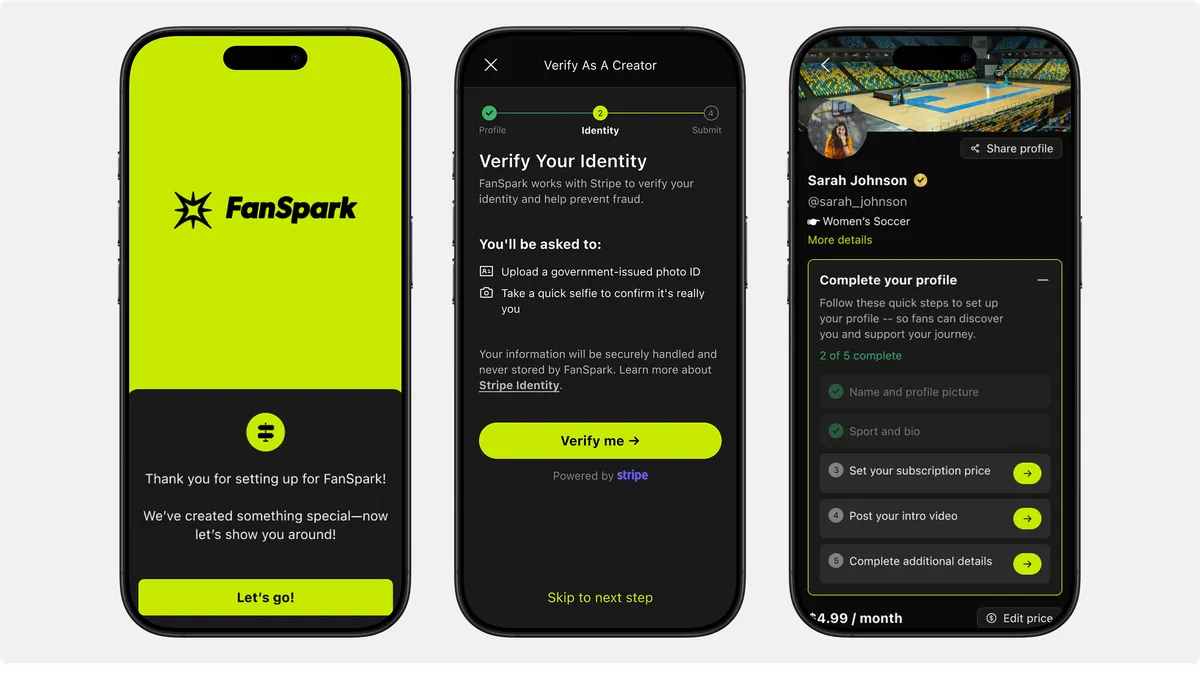
Testing showed that this system enabled over 90% of new creators to complete onboarding successfully within their first attempt. Bonus: The solution also established a reusable pattern that can be scaled easily to new product areas and user roles.
Early version of onboarding drop-off was at 45%, undermining the platform’s growth.
Problem Framing
Business Need
FanSpark exists to help college athletes earn recurring revenue directly from their fans through subscriptions.
Business Problem
With 45% of athletes abandoning onboarding, it translated directly into lost revenue: fewer creators launching meant fewer subscriptions, slowing the platform's overall growth.
People Problem
For athletes, the time and energy spent setting up a profile didn't feel worth the uncertain return — making them less motivated to invest in the platform.
Research
Validating the problem and gaining in-depth insights through research.
I validated the problem through survey, interviews, and usability testing , which confirmed that athletes needed to see value upfront and a clear path to monetization. To identify opportunities for improvement, I mapped pain points onto journey maps to visualize where friction happened and why.
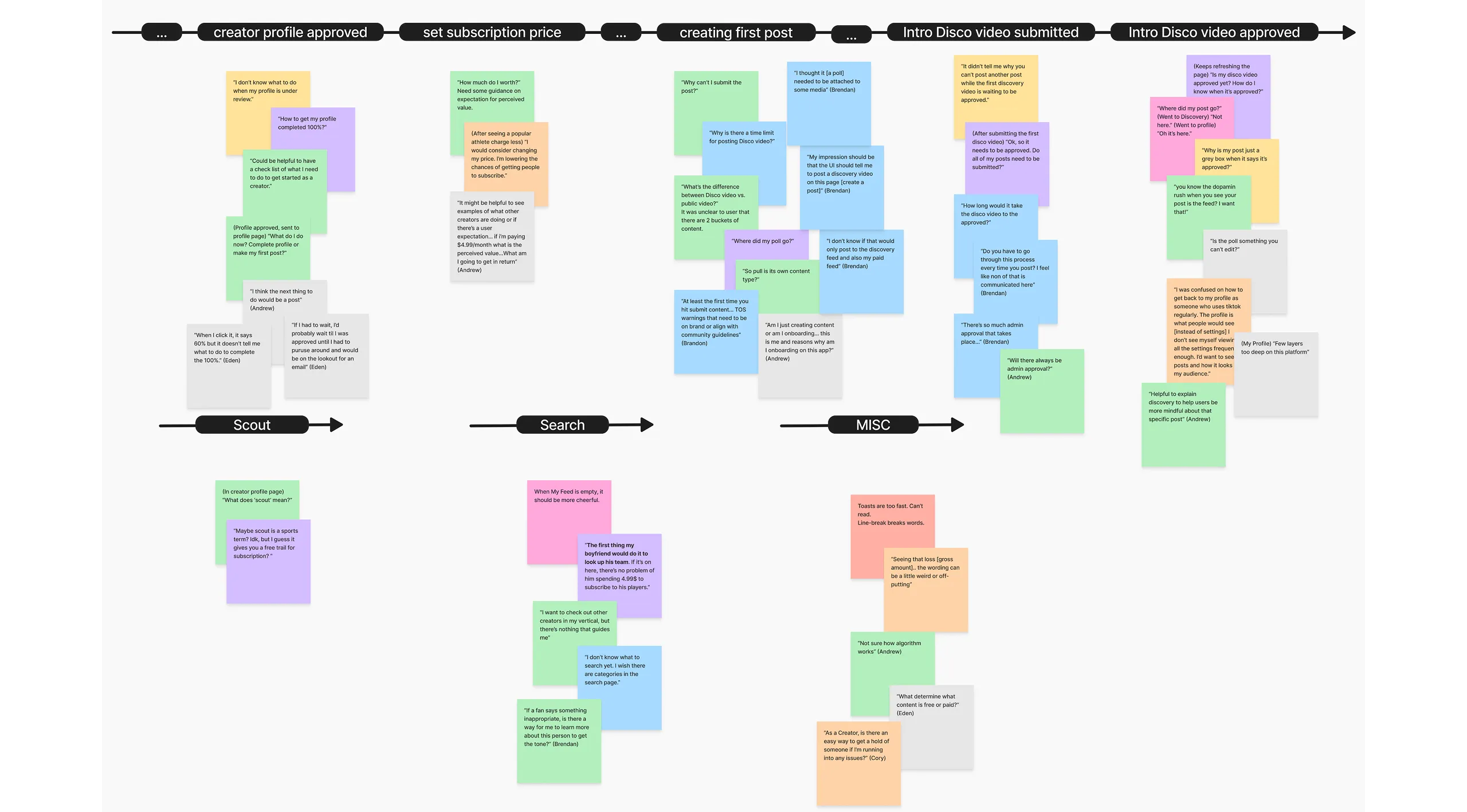
Through research, several pain points were identified that contributed to user drop-offs:
Trust Barrier
25% creators didn't trust the platform with their personal information -- users were reluctant to provide information upfront without seeing values.
Lack of Context
70% creators was not able to grasp the feature setup -- users were confused with the novelty concepts on the platform.
Lack of Guidance
90% creators don't know what to do after existing onboarding -- users struggled to take meaningful actions after signing up.
How might we help new users (athletes creators) see clear, tangible value from FanSpark so they’re motivated to adopt the new platform?
Key Design Decisions
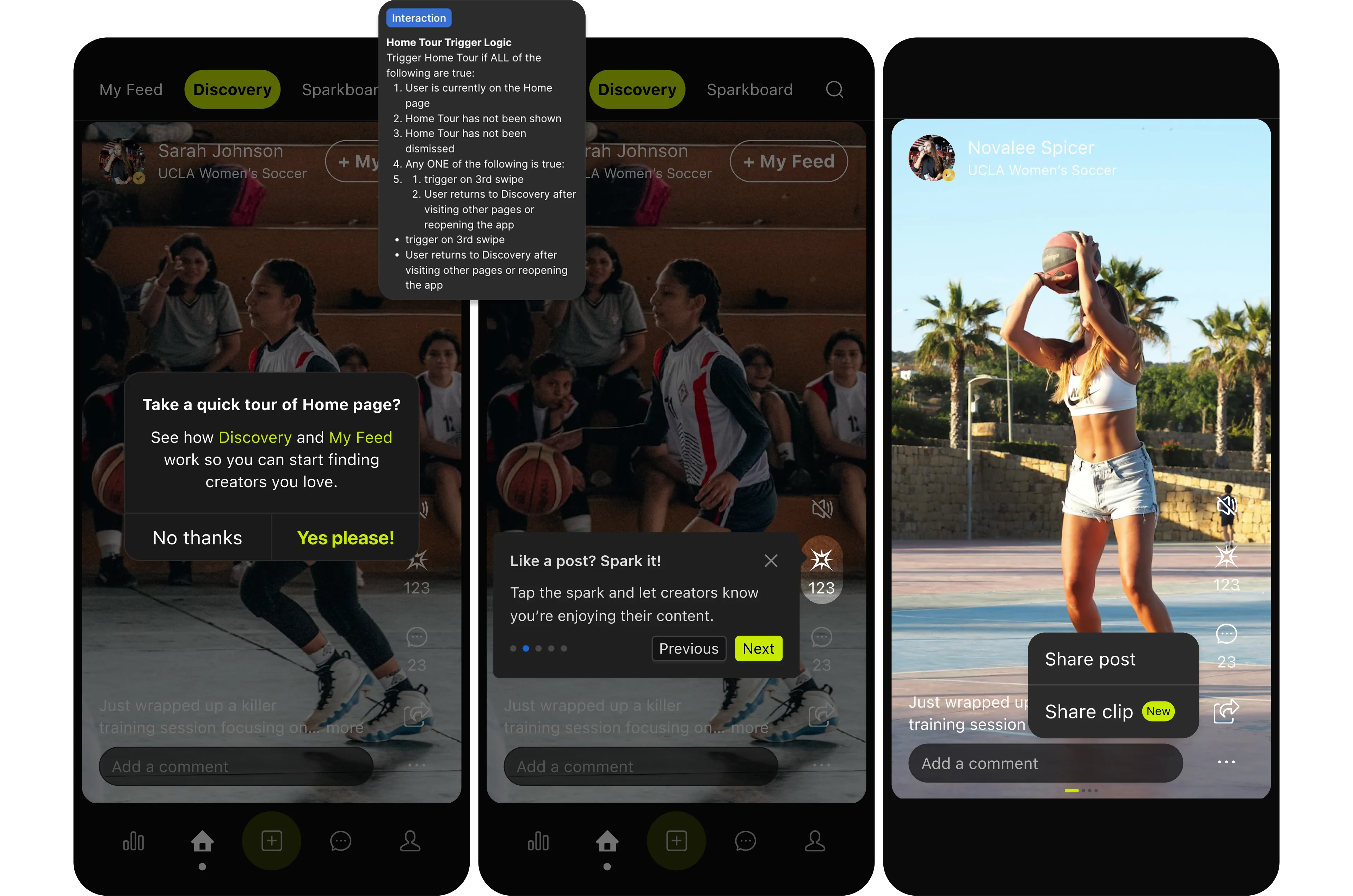
Reduce barriers to reaching the Aha! moment where values are demonstrated
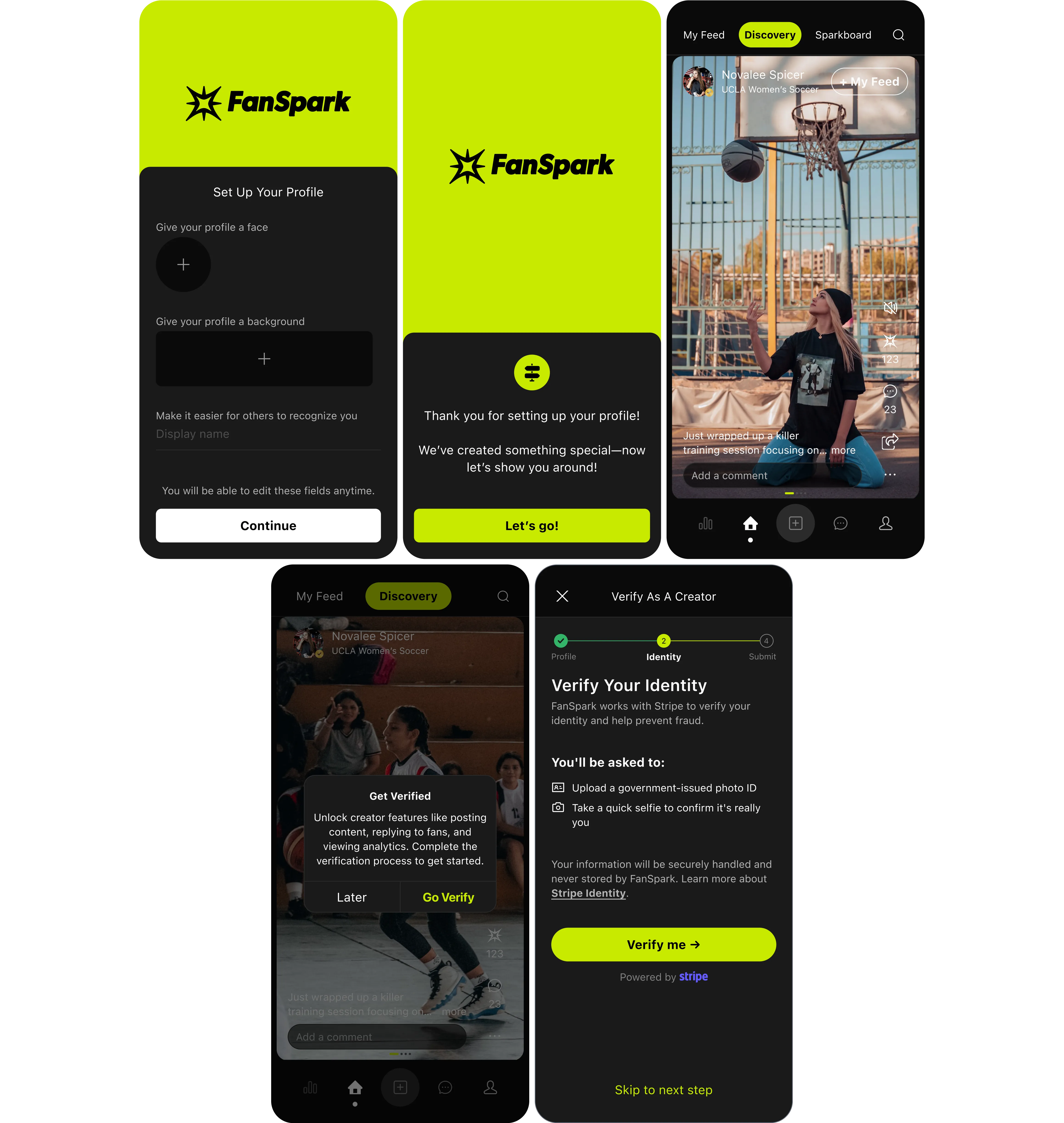
Key Design Decisions
Celebrate small wins
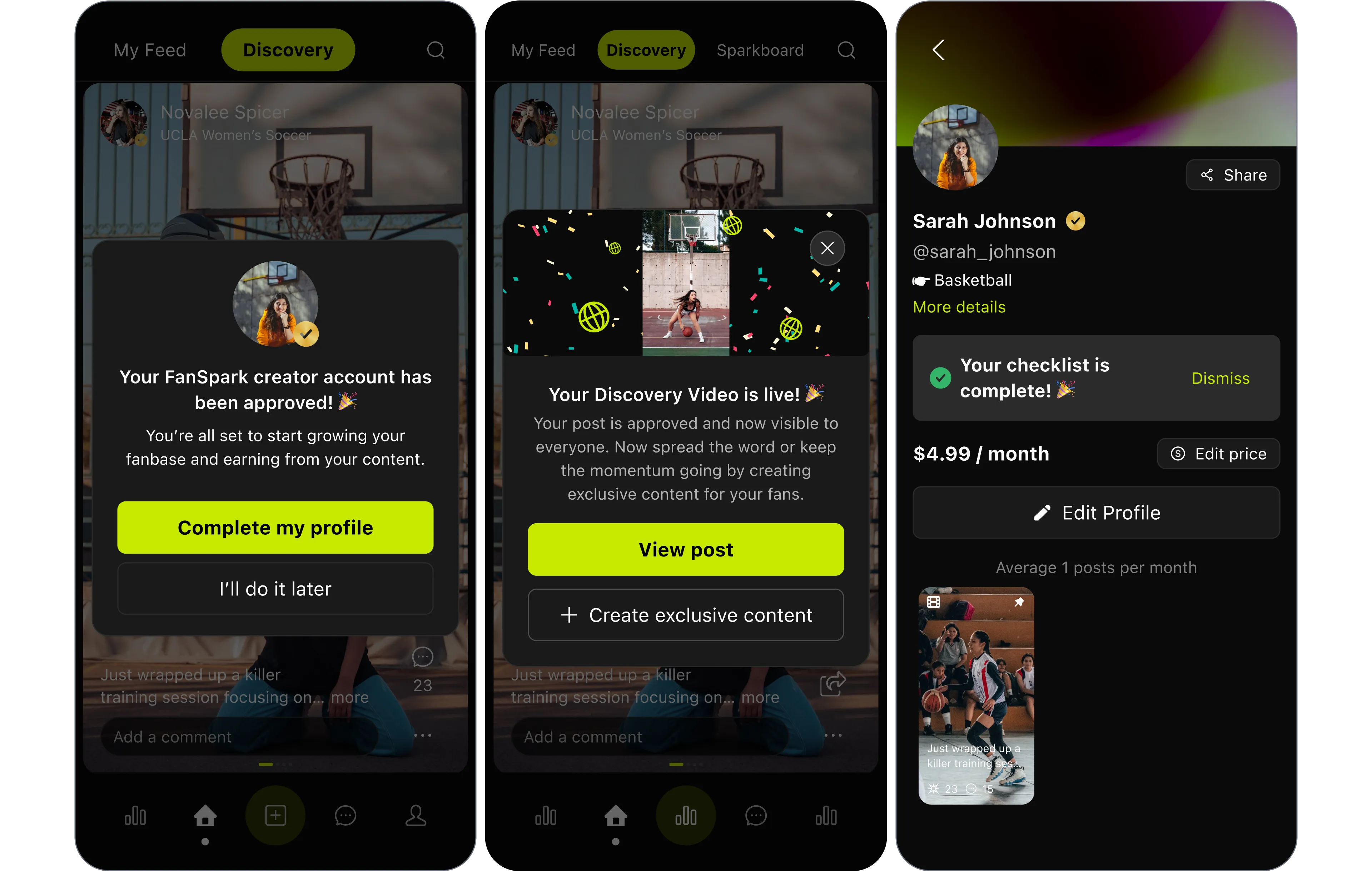
Key Design Decisions
Provide context without disturbing current task
Key Design Decisions
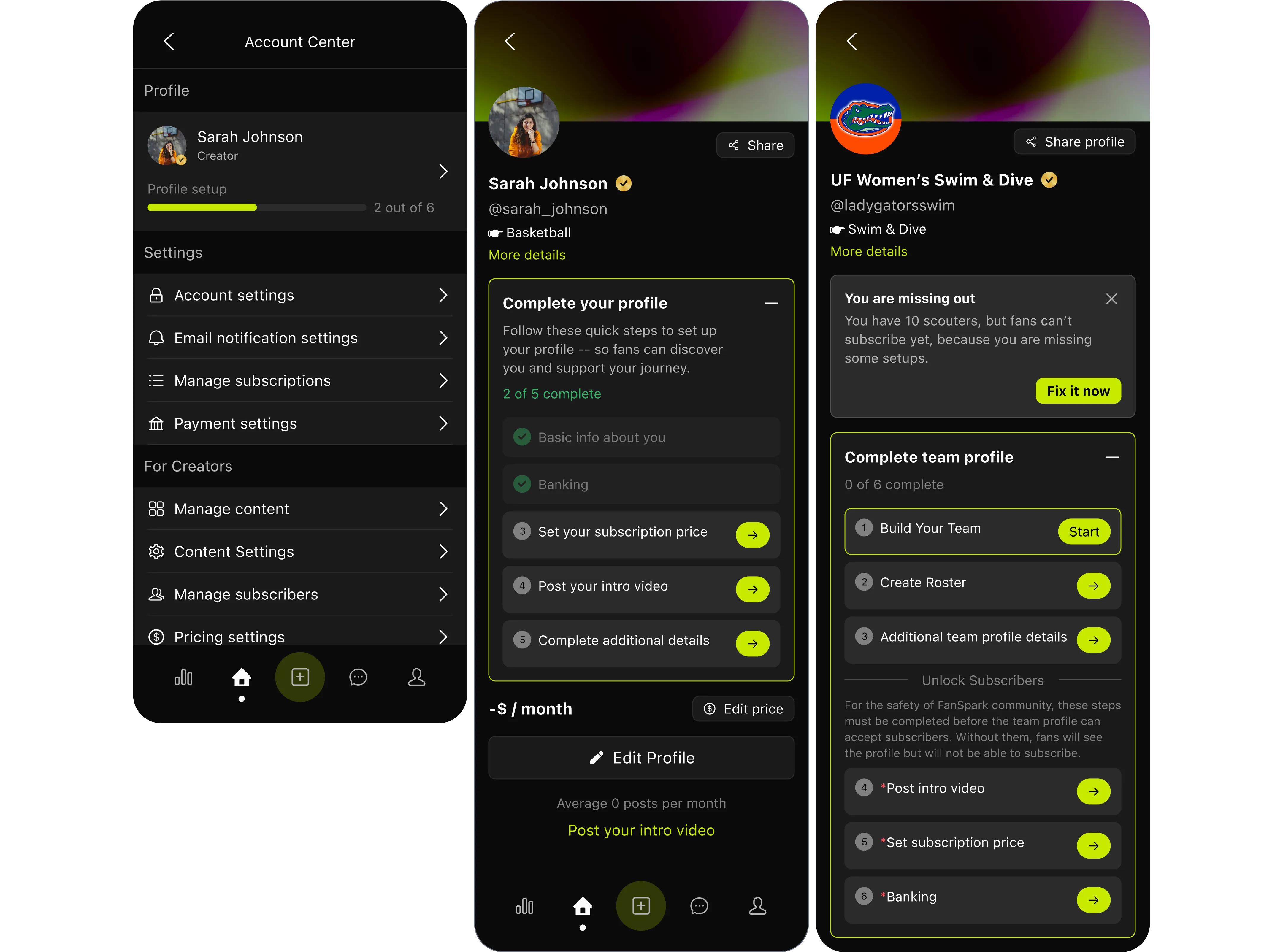
Making the next step explicit with milestone checklists
To reduce uncertainty and keep creators motivated, I implemented a setup checklist that outlined the exact tasks needed. This guided structure gave creators confidence and a direct path to unlocking their first subscribers.
Early testing validated the design decisions:
Over 90% of new creators was able to complete onboarding successfully within their first attempt.
Bonus: the onboarding solutions was scalable to new product/user areas.
Next steps:
Collect quant data through validate this update and spot further pain points.
To measure impact at scale, I partnered with the PM to map the onboarding funnel in Amplitude and track key metrics including drop-off and profile completion rates .
Learnings
At 0→1, the breakthrough came when we put an imperfect version in front of users and let their feedback guide us.
At the start of this project, we had no active users and limited access to athletes, since the sales team was still building connections in a niche market. With no direct user data to guide design, I worked with the team to ship quickly and test early. We released an initial onboarding prototype built on assumptions — such as new users preferring a minimalist flow and maximum freedom to explore. By testing this early version before the platform's launch, we were able to invalidate some of those assumptions and uncover valuable insights. For example, new users actually wanted more guidance as they adapted to a new platform and learned unfamiliar tools. This approach let us redesign onboarding and launch with something that better met real needs.
User problems don't always mirror business problems; asking the right question that tackles both is the key to success.
Earlier in the ideation stage, I explored solutions that aligned with the business goal of generating revenue through freemium content — tools like advanced content creation, content scheduling, and rich interactions under posts. But through talking to athletes and creators, I learned that their frustrations were different — in this case, new users needed help adjusting to a new platform. Finding a solution that addressed both the user problem and the business need was the key to the success of this project.
System thinking is about solving the big puzzle with the fewest pieces.
When designing the onboarding experience for creators, I kept other user groups in mind: fans, team profile managers, athlete agents. When making decisions, I prioritized solutions that could extend across these groups with only small customizations. This system-thinking mindset helped team cut down development time and delivered a consistent experience that made onboarding complex profiles easier, while also driving smoother adoption and stronger conversion across the platform.